

The International Conference “Resilience by Technology and Design” 2026 (RTD 2026), organized by the University of Economics Ho Chi Minh City (UEH) – College of Technology and Design, UEH Mekong, and UEH Nexus Nha Trang in collaboration with international partners, is scheduled from July 15 to 20, 2026.
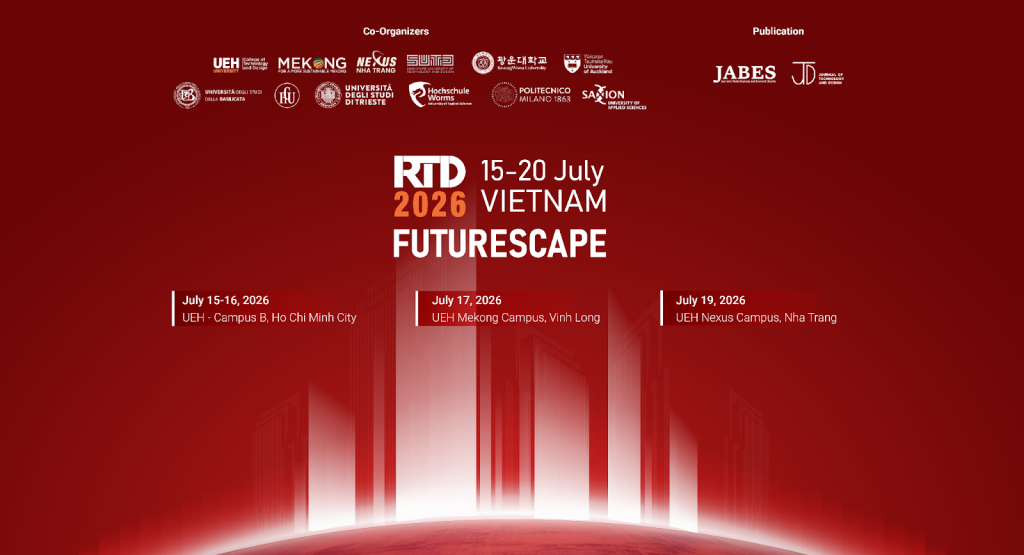
Under the theme “FutureScape – Designing the Future“, RTD 2026 presents a panoramic vision of the future, where emerging technologies, including AI, digital twins, metaverse, and holography, inclusive design, and cross-disciplinary collaboration converge to co-create regenerative and sustainable ecosystems. This theme carries forward the spirit of “Smart Living” (RTD 2022) and “Fostering Sustainability” (RTD 2024), while marking a bold transition toward the integration of technology with social sciences, humanities, and the arts.
RTD 2026 pursues six key objectives:
- Advancing cross-disciplinary future thinking: Encouraging transdisciplinary approaches across technology, design, business, arts, media, and spatial planning to co-create adaptive ecosystems for living, learning, working, leisure, and sustainable economic activity, integrating emerging technologies such as digital twins, metaverse, and holography to enhance collaboration and simulation.
- Bridging technology and sustainable development: Clarifying the role of breakthrough technologies – including AI, Blockchain, IoT, big data, Robotics, digital twin simulation, metaverse platforms, and holography – in transforming business models, smart governance, digital communication, public policy, and global quality of life.
- Fostering multi-stakeholder innovation and co-creation: Strengthening collaboration among universities, businesses, governments, communities, and nature (Quintuple Helix, Living Labs) to co-create innovation ecosystems oriented toward equitable and regenerative development.
- Redefining the role of arts, media, and creative technologies: Elevating the role of arts, media, and creative technologies in shaping mindsets, inspiring action, and driving behavioral transformation toward a sustainable future.
- Developing smart, nature-integrated, net-zero cities: Broadening dialogue and knowledge exchange on the planning, design, and operation of technology-integrated urban-nature models, advancing net-zero cities with climate resilience and ecosystem restoration, leveraging digital twin technology for real-time urban monitoring and metaverse platforms for multi-stakeholder engagement.
- Strengthening the role of higher education in sustainable innovation ecosystems: Affirming the role of higher education institutions and co-organizing partners in leading scientific initiatives, innovation, and cross-disciplinary collaboration to navigate complex global uncertainties, while integrating advanced digital technologies into education, research, and community co-creation.
In alignment with the university’s philosophy of “Academic Excellence with Social Purpose for Innovation and Sustainability”, RTD 2026 is hosted across three strategic hubs, forming a triangle of knowledge, technology, and community that embodies UEH’s multi-hub vision:
1. Ho Chi Minh City – Glocal technology & sustainability: The convergence center of technology, design, and innovation, serving as the global “anchor” for research and collaboration networks.
2. Mekong Campus – Climate adaptation & communities (Local impact, global relevance): A focal point for climate adaptation, community-centered design, and sustainable delta technologies, directly linked to the region’s socio-environmental challenges.
3. Nha Trang Nexus – Oceans & blue economy (Global convergence, local resilience): A hub where global knowledge meets the realities of the blue economy and coastal urban development, advancing sustainable oceans and international connections.
We cordially invite the scholars and experts to submit papers and present research, sharing approaches to the role of technology and design in sustainable development in the following themes, but not limited to:
HO CHI MINH CITY – FUTURESCAPE: Technology, Co-creation and Sustainability Global Technology & Sustainability hub
Topic 1: Business Innovation, breakthrough technologies and sustainability
Subtopics of interest include (but are not limited to):
- Business intelligence and digital transformation for sustainability
- Business innovation and its economic impacts
- Blockchain for transparency and multi-stakeholder governance
- Sustainable business practices and corporate innovation
- The macro-, meso- and micro-level impact of sustainable development policies
Topic 2: Co-Creation, Innovation Ecosystems and Entrepreneurship for the Common Good
Subtopics of interest include (but are not limited to):
- Innovation ecosystems and collaborative governance
- University-led innovation and public-private-societal partnerships
- Entrepreneurship for regenerative business and social impact
- Creative industries, digital platforms and art-tech in co-design
- Holographic and metaverse-enabled co-design methods
Topic 3: Art, Media, and Technology in Sustainable Futures
Subtopics of interest include (but are not limited to):
- ArtTech and immersive storytelling for sustainability
- Digital communication and community co-design
- Creative industries, culture-led regeneration
- Holography and metaverse for immersive art experiences
Topic 4: Data, Robotics, and Intelligence for Planetary Wellbeing
Subtopics of interest include (but are not limited to):
- AI for climate prediction, disaster resilience and nature modeling
- Human–robot interaction in sustainable environments
- Ethical and planetary governance of emerging technologies
- Digital twin-based environmental monitoring
Topic 5: Cross-disciplinary Futures for Net-Zero, Smart and Sustainable City – Nature Systems
Subtopics of interest include (but are not limited to):
- Regenerative urban design and adaptive infrastructure
- Smart, Net-zero cities and climate-responsive planning
- Nature-based solutions, green infrastructure, and ecosystem restoration
- Smart and sustainable mobility, energy, and water systems
- Immersive simulations and stakeholder engagement via metaverse and holography
- Smart governance and participatory city platforms
- Digital twin simulations and immersive urban planning
MEKONG – FUTURESCAPE: Adaptation and Social Innovation
Subtopics of interest include (but are not limited to):
- Climate adaptation and ecosystem restoration
- Circular economy and regenerative community design
- Social innovation and inclusive livelihood models
- Digital tools and participatory planning for resilience
- Nature-based solutions and cross-regional collaboration
NHA TRANG – FUTURESCAPE: Oceans, Knowledge and Convergence
Subtopics of interest include (but are not limited to):
- Blue Economy and Sustainable Coastal Development – Local models for blue growth and resilient coastal cities
- Ocean Technology and Smart Port Systems – AI, IoT, and digital platforms for logistics and maritime transport.
- Marine Ecosystems and Blue – Green Integration – Biodiversity conservation and coastal-mangrove-marine linkages.
- Tourism Futures and Coastal Innovation – Sustainable ocean tourism and service innovations.
- International Knowledge Networks for Ocean Futures – Transnational collaboration on ocean research and climate challenges.
- Policy and Governance for Sustainable Blue Growth – Legal frameworks and governance for marine resource management.
IMPORTANT MILESTONES
• Full Paper Submission Deadline: May 20, 2026
• Acceptance Notification & Invitation Letters: May 31, 2026
• Registration and Payment Deadline: June 12, 2026
Conference Days
• July 15-16, 2026: UEH – Campus B, Ho Chi Minh City
• July 17, 2026: UEH Mekong Campus, Vinh Long
• July 19, 2026: UEH Nexus Campus, Nha Trang
Technical Trips (Optional)
• July 18, 2026: Mekong
• July 20, 2026: Nha Trang
PUBLICATION
Titles, abstracts, and author lists of accepted papers will be included in the conference handbook with ISBN. Authors who presented papers at RTD 2026 can choose to submit their papers to sponsor journals of the conference under a fast-track peer-review process, including Journal of Asian Business and Economics Studies (JABES), Journal of Technology and Design (JTD).
SUBMISSION GUIDELINES
• For detailed requirements and submission instructions for authors, please read Author Guidelines
• Submissions must be made through RTD 2026’s submission portal via this link
• Call for papers via this link
• For more information about RTD 2026 (General Information, Organizing Committee, Keynote Speakers, Submission Guidelines, Registration and Conference fees), please visit the official website: http://rtdconference.info/
RTD 2026 welcomes researchers, experts, and policymakers to join a global conversation, advancing collaborative research and applied innovation to navigate a rapidly changing world, mounting sustainability challenges, and the deepening uncertainties of the 21st century.


